Keywords: Event-Driven Architecture, Apache Kafka, RabbitMQ, Asynchronous Processing, Microservices, Webhooks, Background Jobs, Enterprise Software 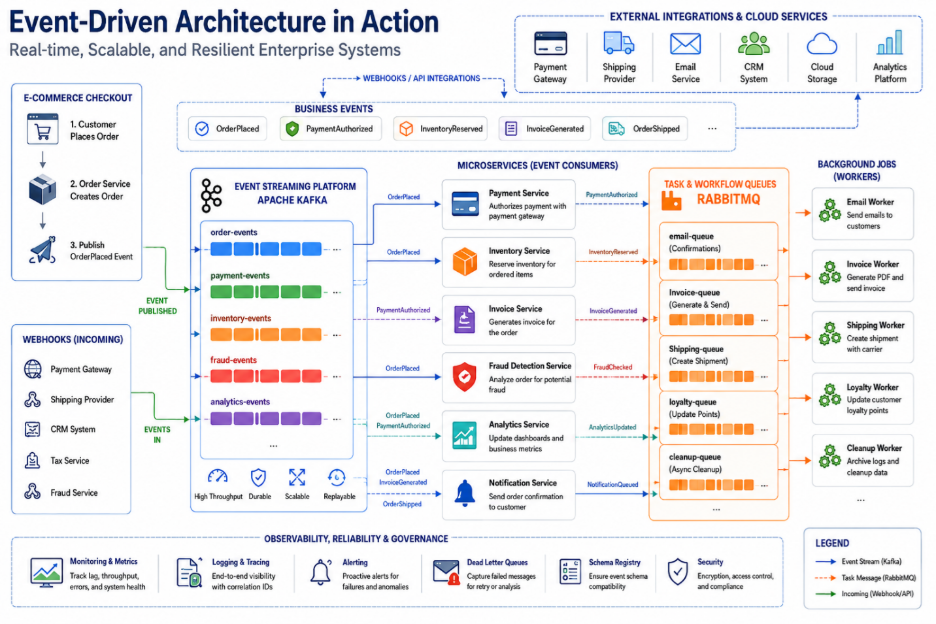
Introduction
Modern enterprise applications are expected to process millions of transactions, integrate with dozens of external systems, and deliver real-time experiences across web, mobile, and cloud platforms. Traditional request-response architectures often struggle to meet these demands because every service depends on another to complete a transaction.
Imagine an e-commerce checkout. Beyond placing an order, the system must authorize payment, reserve inventory, generate an invoice, notify the customer, update analytics, and trigger fraud detection. Executing all of these tasks synchronously increases response times and creates single points of failure.
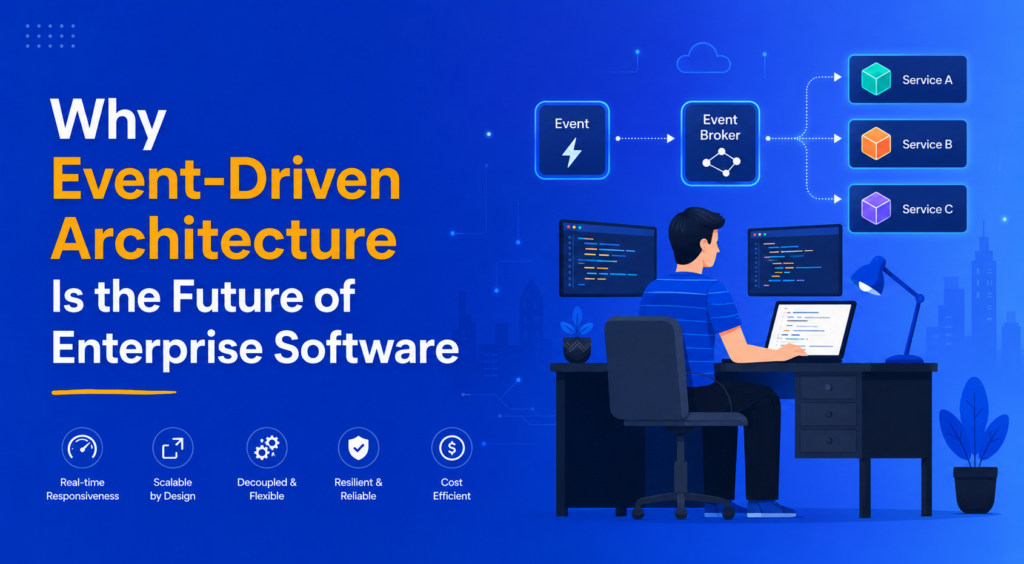
This is where Event-Driven Architecture (EDA) has become the preferred approach. Instead of waiting for every operation to finish, applications publish events—such as OrderPlaced or PaymentAuthorized—allowing independent services to process them asynchronously.
The result is faster, more scalable, and resilient applications, making EDA a core architectural pattern for modern enterprise software.

Why Event-Driven Architecture Matters
At its core, Event-Driven Architecture decouples services. One application publishes an event, while multiple downstream systems subscribe and react independently without tightly coupling business logic.
This approach delivers several enterprise benefits:
- Improved scalability by allowing each service to scale independently.
- Higher resilience because downstream failures don’t interrupt customer-facing operations.
- Faster response times through asynchronous processing.
- Real-time automation for notifications, analytics, fraud detection, and business workflows.
- Simpler integrations across cloud platforms, SaaS applications, and microservices.
Whether building fintech platforms, e-commerce marketplaces, SaaS products, or IoT solutions, event-driven systems enable organizations to respond to business events as they happen.

Kafka vs RabbitMQ: Choosing the Right Messaging Platform
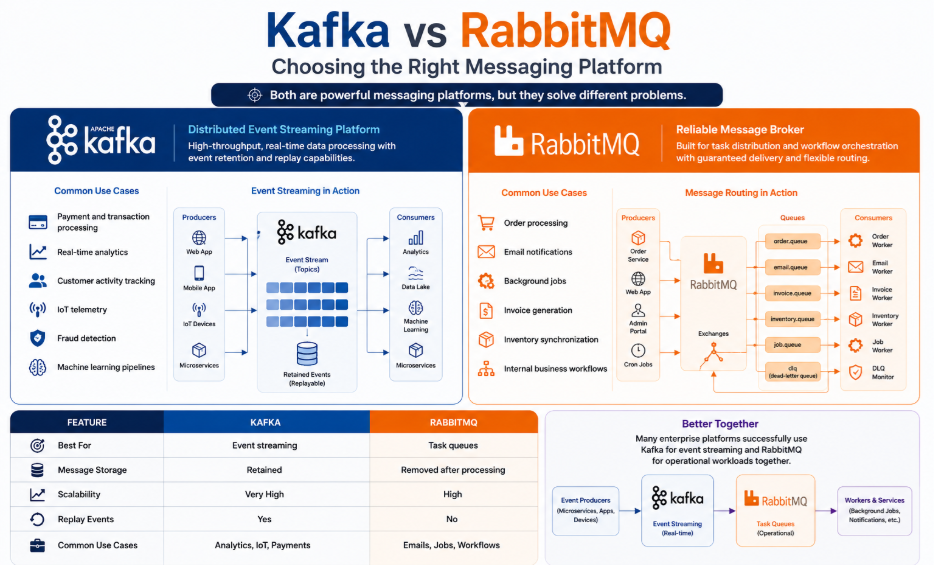
Two technologies dominate enterprise event-driven systems: Apache Kafka and RabbitMQ. While both move messages between services, they solve different problems.
Apache Kafka
Kafka is a distributed event streaming platform designed for high-throughput, real-time data processing. Events are retained for a configurable period, allowing multiple consumers to process or replay them independently.
Kafka is commonly used for:
- Payment and transaction processing
- Real-time analytics
- Customer activity tracking
- IoT telemetry
- Fraud detection
- Machine learning pipelines
Large enterprises often use Kafka as an event backbone connecting hundreds of microservices and cloud applications.
RabbitMQ
RabbitMQ is a reliable message broker built for task distribution and workflow orchestration. Rather than storing long-term event streams, it focuses on guaranteed message delivery and flexible routing.
Typical RabbitMQ workloads include:
- Order processing
- Email notifications
- Background jobs
- Invoice generation
- Inventory synchronization
- Internal business workflows
Its support for acknowledgements, dead-letter queues, and routing patterns makes it an excellent choice for transactional systems.
| Feature | Kafka | RabbitMQ |
| Best For | Event streaming | Task queues |
| Message Storage | Retained | Removed after processing |
| Scalability | Very High | High |
| Replay Events | Yes | No |
| Common Use Cases | Analytics, IoT, Payments | Emails, Jobs, Workflows |
Many enterprise platforms successfully use Kafka for event streaming and RabbitMQ for operational workloads together.

Background Jobs and Asynchronous Processing
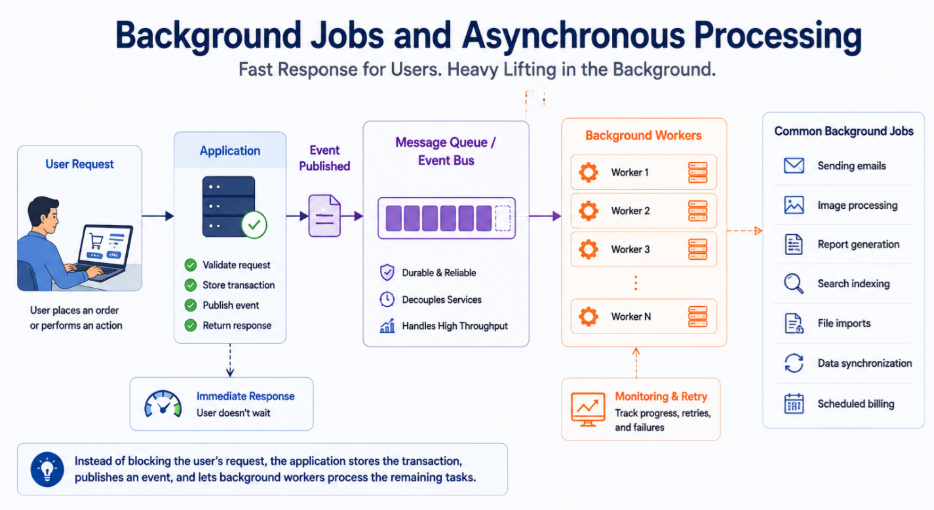
Not every operation should happen while a customer waits.
Background jobs move time-consuming work into worker processes, allowing applications to respond immediately while completing additional tasks behind the scenes.
Common background jobs include:
- Sending emails
- Image processing
- Report generation
- Search indexing
- File imports
- Data synchronization
- Scheduled billing
Instead of blocking a user’s request, the application stores the transaction, publishes an event, and lets background workers process the remaining tasks.
This approach significantly improves responsiveness while enabling applications to scale under heavy workloads.

Webhooks and Reliable Retry Systems
Modern applications communicate with numerous external services including payment gateways, CRM platforms, logistics providers, and SaaS applications.
Most of these integrations rely on webhooks, where external systems notify your application whenever an important event occurs.
Examples include:
- Payment completed
- Shipment dispatched
- Customer updated
- Repository committed
- SMS delivered
Because external networks are unreliable, webhook processing should always include:
- Signature validation
- HTTPS encryption
- Idempotent processing
- Fast acknowledgement
- Asynchronous execution
Failures are inevitable in distributed systems, making robust retry mechanisms equally important.
Best practices include:
- Exponential backoff
- Randomized retry intervals (jitter)
- Maximum retry limits
- Dead-letter queues
- Duplicate event protection
These patterns ensure temporary failures don’t become business failures.

Payment Events: A Real-World Example
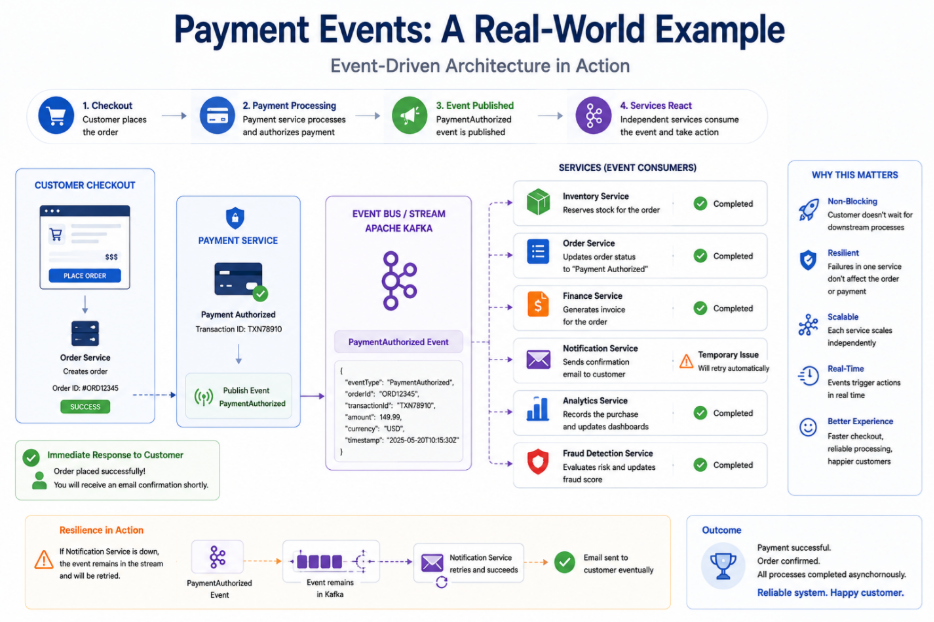
Payment processing demonstrates why Event-Driven Architecture is so valuable.
After a customer completes checkout, the payment service publishes a Payment Authorized event.
Independent services then react automatically:
- Inventory reserves stock.
- The order service updates status.
- Finance generates an invoice.
- Notifications send confirmation emails.
- Analytics records the purchase.
- Fraud detection evaluates risk.
Each service works independently without delaying the customer experience.
Even if the notification service experiences temporary issues, the payment and order remain successful because downstream processing continues asynchronously.
This architecture improves both reliability and customer satisfaction.

Best Practices for Enterprise Event-Driven Systems
Technology alone does not create a successful event-driven platform.
Organizations should establish governance around:
- Event naming standards
- Schema versioning
- Service ownership
- Monitoring and observability
- Security and access control
- Event retention policies
- Consumer responsibilities
Applications should also be designed to handle duplicate or out-of-order events using idempotent processing techniques.
Strong operational discipline is what transforms messaging platforms into reliable enterprise infrastructure.

Conclusion
Event-Driven Architecture has evolved from a niche backend pattern into a standard approach for building modern enterprise applications.
Apache Kafka enables scalable event streaming, RabbitMQ provides reliable workflow messaging, background jobs improve responsiveness, webhooks connect external platforms, and retry systems ensure resilience when failures occur.
Rather than forcing every operation into a single synchronous request, organizations can process events independently, improving scalability, availability, and user experience.
As enterprises continue adopting microservices, cloud-native platforms, AI, and real-time analytics, Event-Driven Architecture will remain a foundational capability for delivering secure, resilient, and highly scalable software.
Organizations that invest in well-designed event-driven systems today will be better equipped to meet tomorrow’s performance, integration, and operational challenges.