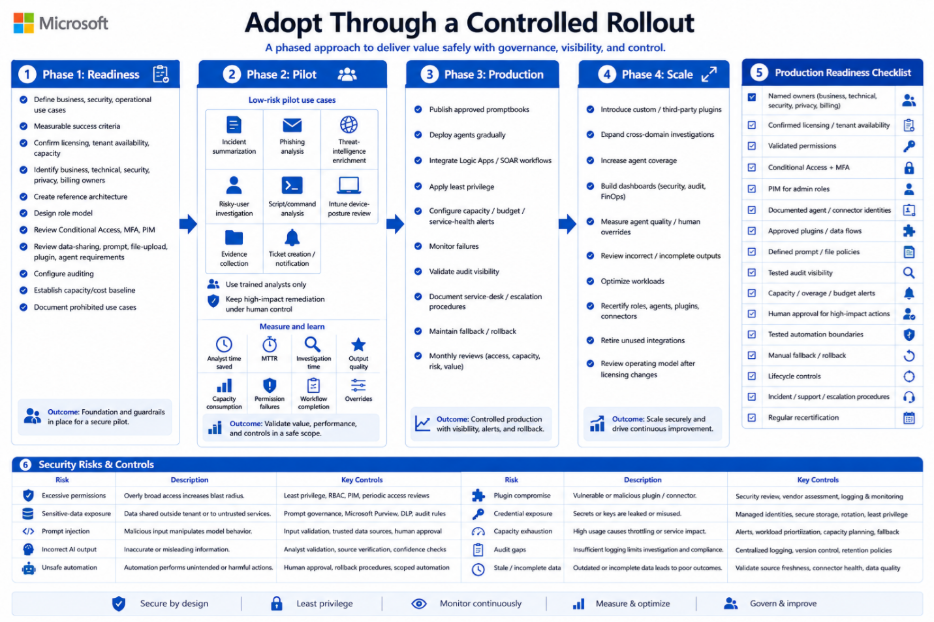
Phase 1: Readiness
- Define business, security, and operational use cases.
- Define measurable success criteria.
- Confirm licensing, tenant availability, and capacity options.
- Confirm whether Security Copilot has already been provisioned.
- Identify business, technical, security, privacy, and billing owners.
- Create the reference architecture.
- Design the Security Copilot and underlying product-role model.
- Review Conditional Access, MFA, and PIM requirements.
- Review data-sharing, prompt, file-upload, plugin, and agent requirements.
- Configure and validate auditing.
- Establish an initial capacity and cost baseline.
- Document prohibited use cases and high-impact actions.
Phase 2: Pilot
Begin with low-risk, measurable use cases such as:
- Incident summarization.
- Phishing-email analysis.
- Threat-intelligence enrichment.
- Risky-user investigation.
- Script and command analysis.
- Intune device-posture review.
- Evidence collection.
- Ticket creation and notification.
Use a limited group of trained analysts. Keep identity disabling, device isolation, policy modification, data deletion, access revocation, and other high-impact remediation actions under human control.
During the pilot, measure:
- Analyst time saved.
- Mean time to triage.
- Mean time to investigate.
- Output quality and required corrections.
- Capacity consumption.
- Permission failures.
- Agent and workflow completion rates.
- Human overrides.
- Unsupported or incorrect conclusions.
Phase 3: Production
- Publish approved and version-controlled promptbooks.
- Deploy approved agents gradually.
- Integrate approved Azure Logic Apps and SOAR workflows.
- Apply least-privilege access.
- Configure capacity, budget, and service-health alerts.
- Monitor agent, plugin, and workflow failures.
- Validate audit visibility.
- Document service-desk and escalation procedures.
- Maintain manual fallback and rollback procedures.
- Conduct monthly access, capacity, risk, and value reviews.
Phase 4: Scale
- Introduce approved custom and third-party plugins.
- Expand cross-domain investigations.
- Increase agent coverage based on measured value.
- Build security, audit, operational, and FinOps dashboards.
- Measure agent completion quality and human-override rates.
- Review incorrect, incomplete, and unsupported outputs.
- Optimize low-value or high-consumption workloads.
- Recertify roles, agents, plugins, connectors, and workflows regularly.
- Retire unused agents and integrations.
- Review the operating model after major platform or licensing changes.
Production readiness checklist
A production Security Copilot service should not proceed without:
- Named business, technical, security, privacy, and billing owners.
- Confirmed licensing and tenant availability.
- Validated Security Copilot and underlying product permissions.
- Conditional Access and MFA protection.
- PIM for privileged administrative roles.
- Documented agent and connector identities.
- Approved plugins and data flows.
- Defined prompt and file-upload policies.
- Tested audit and investigation visibility.
- Capacity, overage, budget, and alert thresholds.
- Human-approval requirements for high-impact actions.
- Tested automated-action boundaries.
- Manual fallback and rollback procedures.
- Agent, plugin, connector, and workflow lifecycle controls.
- Documented incident, support, and escalation procedures.
- Regular role, agent, and integration recertification.

Security Risks and Control Considerations
Security Copilot introduces risks that should be considered during architecture, pilot, and production reviews.
| Risk | Example | Recommended control |
| Excessive permissions | A user retrieves more security data than required for their role | Least privilege, scoped product RBAC, PIM, and regular access reviews |
| Sensitive-data exposure | A prompt or uploaded file contains confidential or regulated information | Prompt governance, file-upload rules, Purview controls, and restricted audit access |
| Prompt injection | Malicious content attempts to influence an agent or plugin | Input validation, trusted data sources, limited write permissions, and human approval |
| Incorrect AI output | A generated conclusion appears credible but is incomplete or inaccurate | Analyst validation, source verification, testing, and quality measurement |
| Unsafe automation | An agent disables an account or changes a policy based on incomplete evidence | Human approval for high-impact actions and tested rollback procedures |
| Plugin compromise | A third-party or custom plugin exposes or manipulates data | Security review, minimum permissions, vendor assessment, logging, and revocation process |
| Credential exposure | API keys or secrets are stored insecurely or written to logs | Managed identities, secure secret storage, credential rotation, and log review |
| Capacity exhaustion | Scheduled agents consume available capacity during a major incident | Capacity alerts, workload prioritization, overage controls, and manual fallback |
| Audit gaps | Agent or plugin changes cannot be reconstructed | Centralized audit logging, change records, version control, and retention policies |
| Stale or incomplete data | Copilot produces a recommendation using delayed or partial telemetry | Validate source freshness, connector health, ingestion status, and data completeness |

Conclusion
Microsoft Security Copilot can become an important part of an enterprise security architecture, but only when it is deployed with the same discipline applied to other critical security platforms.
A secure and sustainable implementation should combine:
- Layered role-based access control.
- Least-privilege user and agent identities.
- Controlled plugins, connectors, and workflows.
- Clear prompt and data-protection policies.
- Audit and investigation visibility.
- Workload-based capacity and cost planning.
- Human approval for high-impact actions.
- Controlled automation for low-risk activities.
- Manual fallback and rollback procedures.
- Continuous measurement and improvement.
The most successful organizations will not necessarily be those that deploy the largest number of agents or automate the highest number of tasks. They will be the organizations that connect Security Copilot to measurable security outcomes while keeping the platform secure, governed, observable, resilient, and financially controlled.
You’ve finished this article. Continue with Deploying Microsoft Security Copilot Securely to learn the next step.